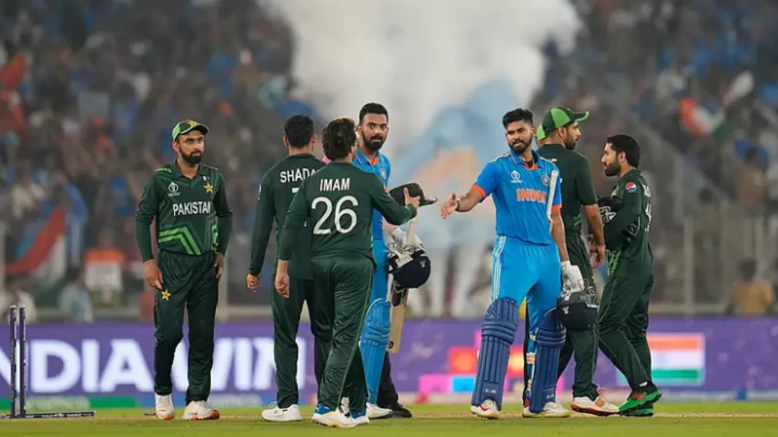
A year after the Pahalgam terror attacks and Operation Sindoor, India has formally opened the route for Pakistani athletes and teams to compete on its soil in international events, laying out a clear policy that separates bilateral relations from global sporting responsibilities.
In an Office Memorandum issued on May 5, the Sports Ministry stated that ‘Pakistani players and teams will be permitted to participate in multilateral events hosted by India,’ while also pointing toward a more simplified visa regime for athletes, officials and international federation representatives.
The policy creates a firm distinction between bilateral and multilateral sport. “In so far as bilateral sports events in each other’s country are concerned, Indian teams will not be participating in competitions in Pakistan. Nor will we permit Pakistani teams to play in India,” the memorandum noted. But in the same breath, it clarifies that for international competitions, “we are guided by the practices of international sports bodies and the interest of our own sportspersons.”
Importantly, it highlights that ‘Indian teams and individual players will compete in international events that also feature teams or players from Pakistan. Similarly, Pakistani players and teams will be able to participate in such multilateral events hosted by India’, opening the way for them to compete in international cricket and multi-discipline events in the country.
The government said that ‘India’s approach to sports events involving Pakistan reflects its wider policy in dealing with that country’. Yet, by formally announcing a dual framework – no bilateral engagement, but full compliance in international sport – the policy aims to balance geopolitical realities with the expectations of global competition, where participation regulations leave little room for exclusion.
The memo stated: “With regard to international and multilateral events, in India or abroad, we are guided by the practices of international sports bodies and the interest of our own sportspersons. It is also necessary to recognise India’s emergence as a dependable venue to host international sports events.”
The notification comes at a significant moment when India is positioning itself as a global sporting centre. The country will host the Commonwealth Games in 2030, and has made a determined push for the 2036 Olympics and 2038 Asian Games. The Olympic Council of Asia (OCA) officials are likely to visit Ahmedabad to review India’s bid. India will also host the cricket Champions Trophy in 2029 and the 50-over World Cup in 2031.
At the same time, in the coming months, Indian and Pakistani athletes are expected to face each other multiple times, at the Commonwealth Games in July-August and the Asian Games in September-October. India and Pakistan are also scheduled to meet in hockey tournaments at least three times in the next few months – in the FIH Pro League in London on June 23 and 26, and again at the World Cup in Amsterdam on August 19.
Sporting relations between the two countries have fallen to an all-time low after the Pahalgam attacks. There was public outrage when India played Pakistan in the 2025 Asia Cup and the T20 World Cup. The government, too, faced criticism for granting visas to the Pakistani hockey team for the Asia Cup in Bihar last August and the Junior World Cup in Chennai in December 2025.
The government also moved to resolve a recurring friction point – visas. In line with its ambition to host major international events, the memorandum said the visa process for ‘sportspersons, team officials, technical personnel, and office-bearers of International Sports Governing Bodies shall be simplified.’ It added that international federation officials will be granted ‘multi-entry visa… on a priority basis for the duration of their official tenure, subject to a maximum period of five years,’ to ensure ‘smooth movement… in accordance with international norms.’
The articulation formalises what has often been handled on an ad hoc basis, particularly in Olympic sports where global federations require open participation.
In recent years, delays and uncertainties over visas for Pakistani, or Pakistan-origin, participants had occasionally drawn criticism from global bodies and raised questions over host obligations. By explicitly stating that multilateral events will remain open, the government appears to be removing uncertainty.
“This (simplified visa process) shall facilitate their smooth movement into and within the country, in accordance with international norms,” the memo stated.
Sports
Government unveils Pakistan sports policy: No bilateral series, participation allowed in international events hosted in India
May 07, 2026