A question has lingered heavily in the hushed political chatter of Patna and elsewhere: After Nitish Kumar, who?
After all, the Janata Dal (United) – which, from its formation, had never really confronted the “leadership question” because of Nitish’s dominance – has experienced dramatic shifts in recent times.
First, Nitish stepped down as Bihar’s Chief Minister and was sworn in as a member of the Rajya Sabha, paving the path for the state’s first BJP CM.
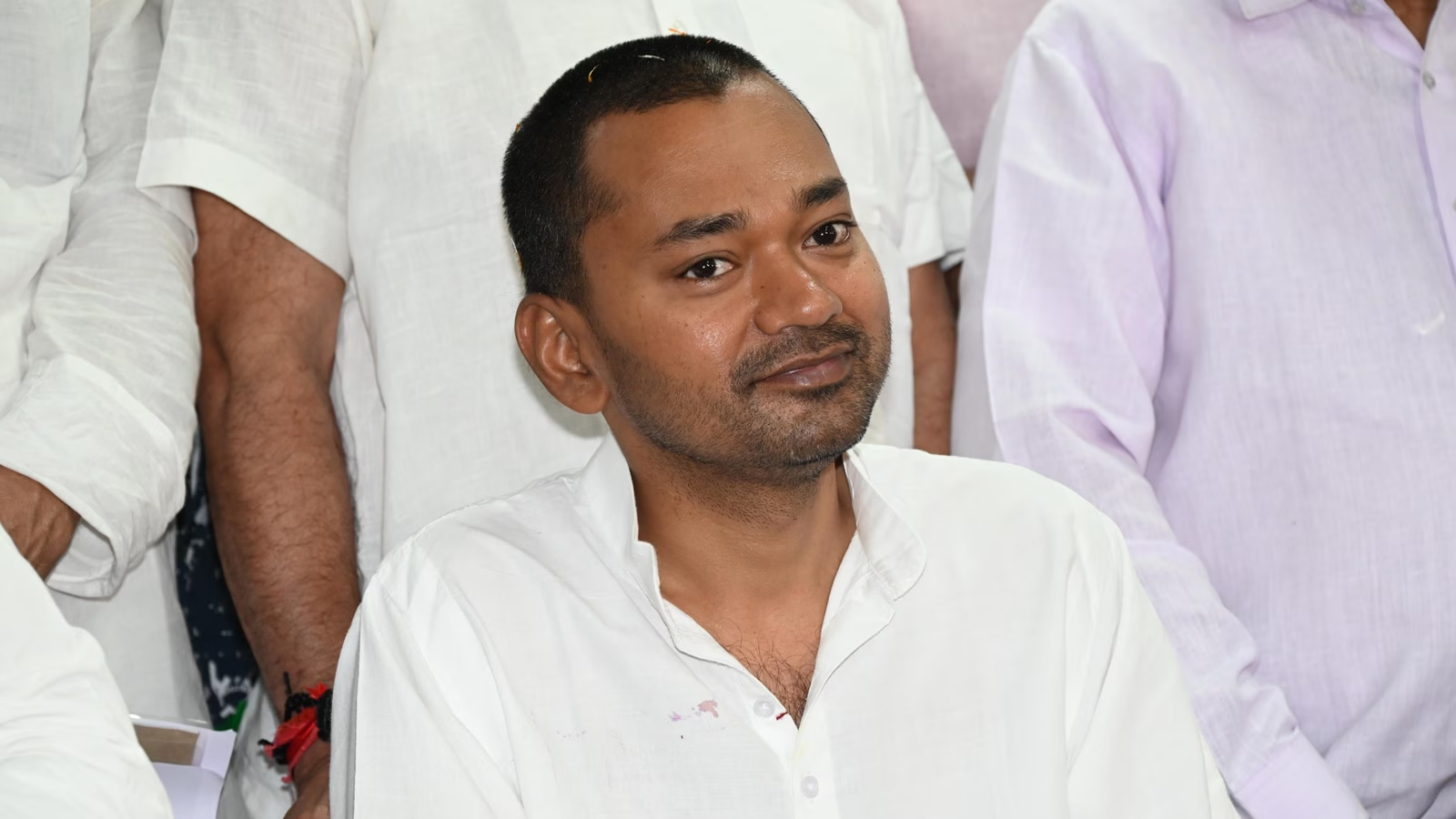
Then, Nitish’s son, Nishant Kumar, emerged from his father’s shadow: he entered the party on March 8 and was appointed Health Minister in the Samrat Choudhary government on May 7.
Nitish still heads the party in name, but concern is growing over identifying his successor, someone capable of handling the intricacies of the alliance with the BJP, particularly now that it is the “senior partner”. For numerous party workers and leaders, that person is Nishant.
Nishant’s arrival in politics was not sudden. It had been anticipated for some time.
On February 14, he reached Bodh Gaya to begin his first broad tour across Bihar. Wearing a white kurta-pyjama and a cream sweater, he moved through the renowned Mahabodhi temple, understanding its history, meditating beneath the Bodhi tree, and interacting with foreign tourists. Photographs captured him offering respects to the Buddha and posing beside a monk.
It was hardly Nishant’s first trip to Gaya. Only this occasion, he was neither a curious traveller nor a pilgrim. The schedule next brought him to the Tater reservoir, part of the Ganga Water Supply Scheme. Standing near the water body, he fired a series of questions at officials as they briefed him regarding the project. He also visited the Dashrath Manjhi Memorial, where he paid homage to the “Mountain Man”.
Earlier in the year, Nishant had participated in several carefully planned party programmes across the state, engaging with leaders and workers. Since there was no election approaching, political circles in Patna reflected on the obvious question: was the chief minister’s only son finally preparing for his political debut after decades away from the spotlight?
At that stage, Nitish appeared firmly settled in his position. Now serving his 10th term as Chief Minister after guiding the National Democratic Alliance to a sweeping victory, the 74-year-old’s hold over the state appeared unquestioned. But whispers within his party, and outside it, concerning his declining health and, consequently, the urgency of identifying a successor had started becoming louder.
It did not take long for Nishant to emerge as almost the sole practical option.
Now that he has entered the contest, Nishant’s biggest strength is also his principal weakness: his only qualification is that he is Nitish’s son.
He has started his political journey at 53. By that age, his father had already served as a Union minister and Chief Minister. If political instinct runs through lineage, Nishant may steer his way smoothly. Otherwise, he will need to learn rapidly to survive the ruthless depths of political life.
Nishant was born on July 20, 1975. He shared a close bond with his mother, Manju Sinha, who practically brought him up alone as Nitish was rarely home, constantly occupied with politics.
Nishant first studied at St Karen’s School in Patna. But a disciplinary episode, which allegedly involved a teacher striking him, affected him so deeply that he was transferred to Manav International School in Mussoorie. Nishant disliked staying away from his family, however, so he was admitted to Patna’s Central School, where he completed Class 12.
Between 1998 and 2002, he pursued a B.Tech in Computer Science at the Bihar Institute of Technology (BIT) in Ranchi. Despite strong academic performance, he neither attended campus interviews nor accepted a job. Instead, sources say, he returned to Patna, residing at his maternal grandparents’ home in Kankerbagh. While Nitish, serving intermittently as Union minister between 1989 and 2004, travelled between Delhi and Patna, Nishant remained largely in Patna with his mother. Manju, a public school teacher, never shifted into Nitish’s official residence when he was Union Minister or CM. She died in 2007.
After his mother’s death, Nishant moved in with his father at 1, Aney Marg alongside his extended family, including cousins from both sides of the family.
A former legislator recalls: “After the demise of his wife, Nitish appeared more attentive towards his son. He preferred Nishant to remain close at home rather than immediately enter a professional career.”
By most accounts, Nishant has maintained a private life. Slightly built, with closely cropped hair, he is generally seen in kurta-pyjamas. In photographs, he appears clean-shaven with a tidy moustache; at other times, with a fuller beard. He avoids luxury vehicles and travels with minimal security, sources say.
Friends from BIT — including Islampur MLA Ruhail Ranjan (son of the late Rajiv Ranjan), Arjit Shashwat (son of former Union Minister Ashwini Kumar Choubey), Rajesh Choudhary (brother of Bihar CM Samrat Choudhary), and Amit Chourasia (son of former Sikkim Governor Ganga Prasad) — describe him as intelligent, polite, and grounded.
Recalling an incident from 1999, when Nitish was Union Railways Minister, Ruhail says: “We had to board a train from Ranchi to Patna. While my ticket was confirmed, Nishant’s was not. He didn’t send a request for confirmation. Eventually, we shared one berth…For the first two years at BIT, nobody knew he was Nitish Kumar’s son.”
“Bihar would be fortunate if someone like Nishant, with such humility and social values, becomes CM one day,” Ruhail adds.
Another source says that Nishant remained informed about the state’s administration even while staying away from politics. “He has studied the Jal, Jeevan Haryali mission extensively,” the source says, referring to a scheme launched in 2019.
Those close to Nishant say he is an enthusiastic reader of books on socialism, the RSS, modern Bihar, and religious texts. His bookshelf includes titles such as “India’s Silent Revolution (Christophe Jaffrelot)”; “Ram Manohar Lohia (Indumati Kelkar)”; “Single Man: The Life & Times of Nitish Kumar of Bihar (Sankarshan Thakur); “RSS: The Long and Short of it (Devanura Mahadeva)”.
Family acquaintances draw similarities between father and son. “Both possess spiritual inclinations,” says one. “After engineering, Nitish read Osho extensively. Nishant, too, reads mystical and spiritual literature, both Indian and international.”
Do father and son discuss politics? A source working at Nitish’s official residence says, “Once Nitish Kumar is home, it’s an ordinary father-son conversation. Politics is rarely discussed at the dinner table.”
According to annual property disclosures, Nitish has transferred his ancestral assets to Nishant. The holdings, valued at around Rs 3.61 crore, include immovable property worth approximately Rs 1.98 crore in Kalyanbigha village and Bakhtiyarpur.
Because he was accelerated into politics, Nishant remains politically inexperienced. Party leaders say Nitish had long resisted the idea of his son entering politics. His long-standing criticism of dynastic politics — directed at Lalu Prasad Yadav’s Rashtriya Janata Dal (RJD) and Ram Vilas Paswan’s Lok Janshakti Party (LJP), now led by their sons Tejashwi Yadav and Chirag Paswan, respectively — made any attempt to elevate his own son a sensitive decision.
“He became so upset once and declared that as long as he was around, there should be no further discussion of bringing Nishant into politics,” a JD(U) leader recalls.
Yet, indications that Nishant would make the leap appeared as soon as it became evident Nitish was preparing to step back.
In February last year, a Facebook profile appeared. Its name, in Hindi, was strikingly simple: Nitish ke Nishant. It shared photographs of Nishant at public programmes and with his father. One July 21 image showed him embracing Nitish. Another, after the Bihar election victory, carried the caption: “Today, my greatest joy is my father’s historic victory… I am proud to be your son.”
Sources say Nishant does not have a social media team and that the page is managed by his nephew, Anuraj, who is a trained pilot.
On January 8 last year, Nishant made his first major political remark. Accompanying Nitish to his hometown Bakhtiyarpur to unveil statues of freedom fighters, he told reporters in Hindi: “Vote for JD(U) and my father and bring him back.”
Now that he has formally entered politics, the question remains: Is he suited for it?
Party leaders acknowledge that Nishant is a newcomer but say his ringside observation of Bihar’s politics and political manoeuvring over the last two decades will help him considerably.
“If Tejashwi could become Deputy CM at 25, Chirag Paswan could become chairman of LJP’s parliamentary board in 2013, and Deepak Prakash [son of Rashtriya Lok Morcha chief Upendra Kushwaha] could become a minister without being an MLA or MLC, why couldn’t Nishant join politics?” a JD(U) leader asks.
Is he the appropriate choice, though?
Over the years, party sources say, Nitish explored potential successors outside the family — Upendra Kushwaha, former JD(U) president RCP Singh, and even political strategist-turned-politician Prashant Kishor. In the end, none emerged as a lasting second-in-command.
Within the party, there were two broad — though undeclared — camps on the matter: one inclined to preserve the status quo and the other favouring a roadmap involving Nishant.
Among the status quo supporters were Lalan Singh and the national working president Sanjay Kumar Jha. While Jha — frequently described as the BJP’s man in the JD(U) — had publicly kept the possibility of Nishant entering politics open, he and Lalan Singh were reportedly cautious about any transition that could disrupt the existing balance of power.
Along with Deepak Kumar, principal secretary to Nitish, they are widely viewed as the party’s central decision-making group.
At the same time, two sets of people were trying to persuade Nitish to approve Nishant’s entry: family members and some party leaders. “Both were telling Nitish that the BJP could ‘swallow up’ the JD(U) once Nitish was no longer in command… They argued that Nishant alone could keep the party united, guide it through the next Lok Sabha and Assembly elections, and ensure the party’s survival against a powerful BJP,” says a source.
The BJP and JD(U) have been allies for years. Yet Bihar remains a frontier for the BJP’s independent expansion.
Within the family, those supporting Nishant’s cause reportedly included Nitish’s elder brother Satish Kumar and Nishant’s maternal uncle, Prakash Singh. After Manju’s death, Prakash and his wife moved into the CM’s residence. Satish began living there after their mother, Parmeshwari Devi, died in 2011.
Satish has even spoken publicly in support of his nephew. “I will speak to Netaji,” Satish told the media at Kalyanbigha earlier this year, referring to his brother.
It wasn’t long before support for Nishant became explicit. During Makar Sankranti in January, on a service road opposite the JD(U) office on Bir Chand Patel Path, posters celebrating the harvest festival were installed. One poster, put up by Krishna Patel, state vice-president of Chhatra JD(U), stood out — it displayed images of Nitish and Nishant.
It also carried a message in Hindi: “Unanimous leader of the party, please recognise the emotions of party workers. A servant of Nitish Kumar demands Nishant…The arrow is the symbol of Uncle Nitish’s dreams and Brother Nishant is the future of this arrow.”
The symbolism was impossible to overlook. The festival marks the end of the “inauspicious” month of Kharmas when new beginnings are traditionally expected.
The road ahead
From the era of George Fernandes and Sharad Yadav to the phase under RCP Singh and Lalan Singh to the current structure with Sanjay Kumar Jha, the party has arrived at a crossroads. Its three most senior leaders — Lalan Singh, Vijay Kumar Choudhary and Sanjay Kumar Jha — all come from upper-caste backgrounds, sitting somewhat awkwardly with the party’s OBC-driven, socialist political roots.
Sources say none of them is regarded as a natural successor to Nitish. Jha is considered too close to the BJP. Lalan Singh is over 70. Choudhary, who has roots in the Congress, is viewed as a consensus-builder who works within the leadership’s framework rather than asserting an independent position.
Among the younger generation, too, there is no clear claimant. In this vacuum, sources say, Nishant appears to be the only practical option.
“The party understands it would be extremely difficult to justify Nishant’s entry into politics, but it has no alternative,” a senior JD(U) leader says. “We would rather be pragmatic than disappear as a political party because of Nitish’s stand. The same Nitish who had never permitted Nishant to visit the JD(U) office was pleased to see his son at the party office recently. This indicates that he’s softening his position on dynastic succession.”
Interestingly, Opposition leaders had welcomed the idea of Nishant entering politics. Former CM Rabri Devi said Nishant should step in. Leader of Opposition Tejashwi Prasad Yadav went further: “If Nishant Kumar does not join the JD(U), the BJP would consume the party.”
The strongest endorsement, however, came from RJD national vice-president Shivanand Tiwari: “I have seen Nishi grow. He has remained entirely non-controversial so far, something quite remarkable. I have heard him speak on politics. He has my blessings.”
Politics, however, is a ruthless arena and entering at the deep end without much experience can be dangerous.
Both Nitish and the BJP have long made opposition to dynasty politics the central plank of their attacks on rivals, especially the Congress. Nishant’s entry into the Cabinet has weakened that criticism. But whether this will, in any manner, affect his rise to the top is a question only time will answer. Nishant has begun his innings in politics and governance; his every move, his every decision will now be under public scrutiny. Nishant’s success or failure will not only shape his own future, it will also have a serious impact on the future of his father’s party.