INMASTERMIND
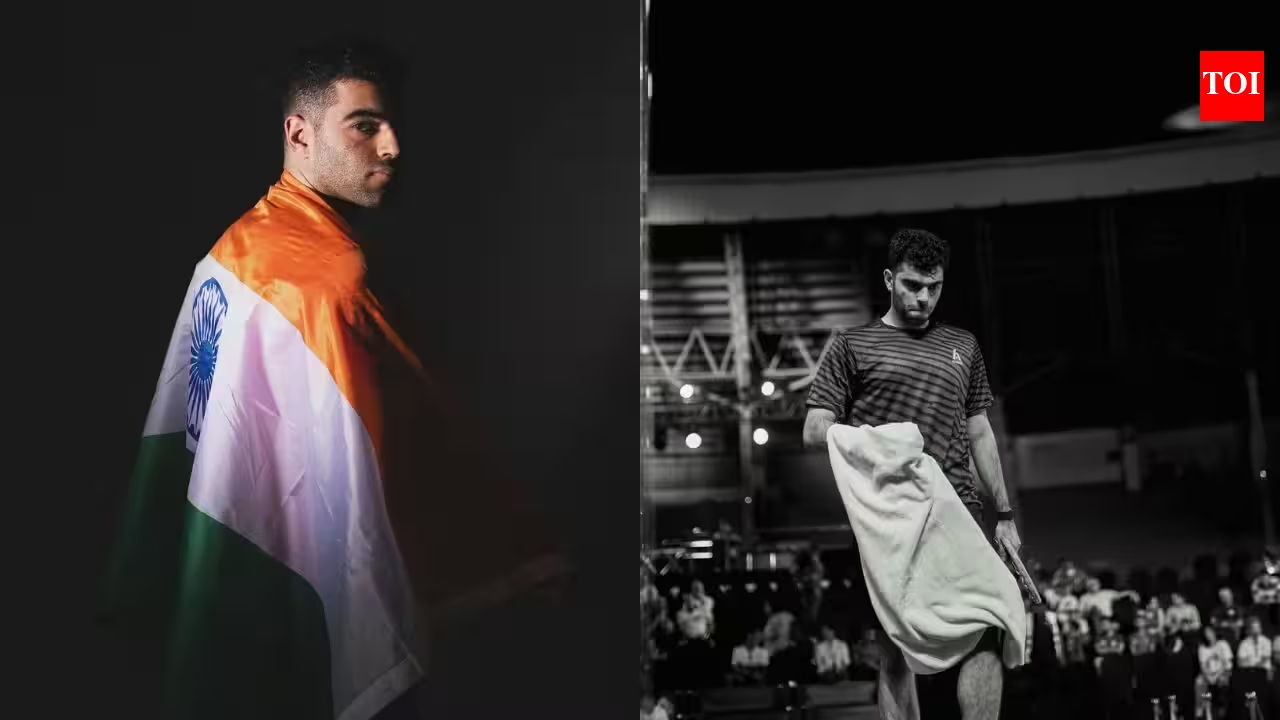
NEW DELHI: Veer Chotrani doesn't recall learning to love squash, largely because there was never a version of his life without it. "I've been around squash for the last 20 years," the 24- year-old told TimesofIndia.com during an exclusive interaction. "I was basically born on a squash court, because my father (Manish Chotrani) was a national champion playing for India." He began formal coaching at four, was playing tournaments by six and seven, and developed into a decorated junior career, which included several Asian Junior titles and a stint as India's junior No. 1 across age categories. It's the sort of story Indian squash needs more of right now, at precisely the moment the sport finally has the nation's attention. Just weeks earlier, 18-year-old Anahat Singh became the first Indian ever to win the World Junior Squash Championship, beating Egypt's Ruqayya Salem in the final to end a 16-year run in which no non-Egyptian had won the girls' title. India's junior boys followed with a bronze. And on the men's PSA tour, Chotrani, currently ranked 38th in the world, sits alongside Abhay Singh (24th), Ramit Tandon, and Velavan Senthilkumar as part of a genuinely rare cluster: four Indian men inside the world's top 60 simultaneously, for more than a year running.
The spark squash needed Before Anahat, it was the Olympics, Chotrani feels. Squash's inclusion on the program for Los Angeles 2028 reshaped the sport overnight, in India specifically. "Any sport that makes the Olympics for the first time is going to receive a lot more publicity, a lot of eyeballs," he said. "Especially in India, I think the audience here loves champions, in every sport." Anahat Singh's World Junior victory arrived inside exactly that window, giving Indian squash a headline moment tied directly to Olympic ambition. "Because squash is an Olympic sport, people have confidence in her making it into the Olympics and doing very well for us," Chotrani said. "I think the Olympics was the main reason squash became what it is today in the last couple of years, and that we've been performing on the world stage." The Cornell connection and how it worked Chotrani's own route off the junior circuit went through Cornell University, where he studied psychology and trained under David Palmer, the former world No. 1 who remains his coach today. "The standard of squash in the US collegiate circuit is so high that if you break through and do well there, you have everything you need to give it a shot in professional sport," he said, explaining why three of India's current top four men have all used facilities in the US .
Fuelling their motivation to work harder is the growing rivalry between the two compatriots. Chotrani and Abhay Singh, India's current No. 2 and No. 1, played each other three times last season and divided the rivalry 2-1 in Chotrani's favour, including a first-ever meeting in New York, a defeat to Abhay in the JSW Open final in Mumbai, and a victory at the World Championships in Cairo last May. "It's always difficult to play someone from your own country, especially in the big tournaments," Chotrani said. What the rivalry does give him, he added, is a target: "It's great to have someone ahead of you that you're chasing. But I also have to remember I have Ramit and Velavan right behind me. All four of us are at the same level on our best day."
The gaps that still persist For all the momentum, Chotrani is realistic about the structural gap still separating India from squash's traditional powers, like Egypt. The issue, in his telling, isn't infrastructure. "We have the courts, we have the facilities," he said. "What we need is the proper guidance and the right people to help not just the players competing right now, but the next generation too." The clearest evidence being none of India's top four men actually train within the country. "Why is that? Because we don't have the right training partners to make us better. We have to be outside India most of the time." He contrasts that with Egypt, squash's dominant nation for decades. "A 10-year-old training in a club in Egypt has one of the best players in the world training in that same club to look up to. They have that inspiration, the top coaches, they have everything there," he explained. It's a culture gap as much as a resource one, and Chotrani knows it. Government funding has begun flowing toward the sport, he agrees, but turning that into a genuine home-grown ecosystem, one capable of housing foreign coaches, fitness staff, and sports psychologists under one roof, is the next major project. "None of us would have to go abroad to train. That's what everyone wants," he added. Indian culture is a very academic culture Veer Chotrani There's another hurdle that extends beyond funding and training facilities. It concerns what an Indian family expects from a child. "Indian culture is a very academic culture," Chotrani said with a smile. "Every family wants their kids to have a degree, to pursue medicine or engineering. It's very uncommon for a kid to tell their parents, 'I want to be an athlete.'" Most junior players in India, he said, take his own route with strong junior careers, followed by a U.S. degree, after which many simply stop competing. He's careful not to portray that as a lack of will. "It's not wrong at all," he said, pointing to himself, Tandon, and Velavan as proof the two paths aren't mutually exclusive. What comes next, in Chotrani's own assessment, depends less on talent and more on whether the country finally creates somewhere for that talent to remain and train. He remarked, "There are people who've done everything: played junior squash, earned a degree from a good school, and are still playing on the professional tour right now. You can do that too."